Automation vs AI Workflows vs AI Agents: Understanding the Differences
Overview
Automation, AI Workflows, and AI Agents - these terms flood our feeds daily, often used interchangeably. But they represent fundamentally different approaches to solving problems with distinct capabilities, use cases, and architectural considerations.
Understanding these differences is crucial for making informed architectural decisions. Choose the wrong approach and you might over-engineer a simple problem or under-design a complex one.
This guide clarifies the distinctions and helps you choose the right tool for your specific needs.
The Autonomy Spectrum
The key differentiator is autonomy with purpose. Each approach represents a different level of decision-making independence:
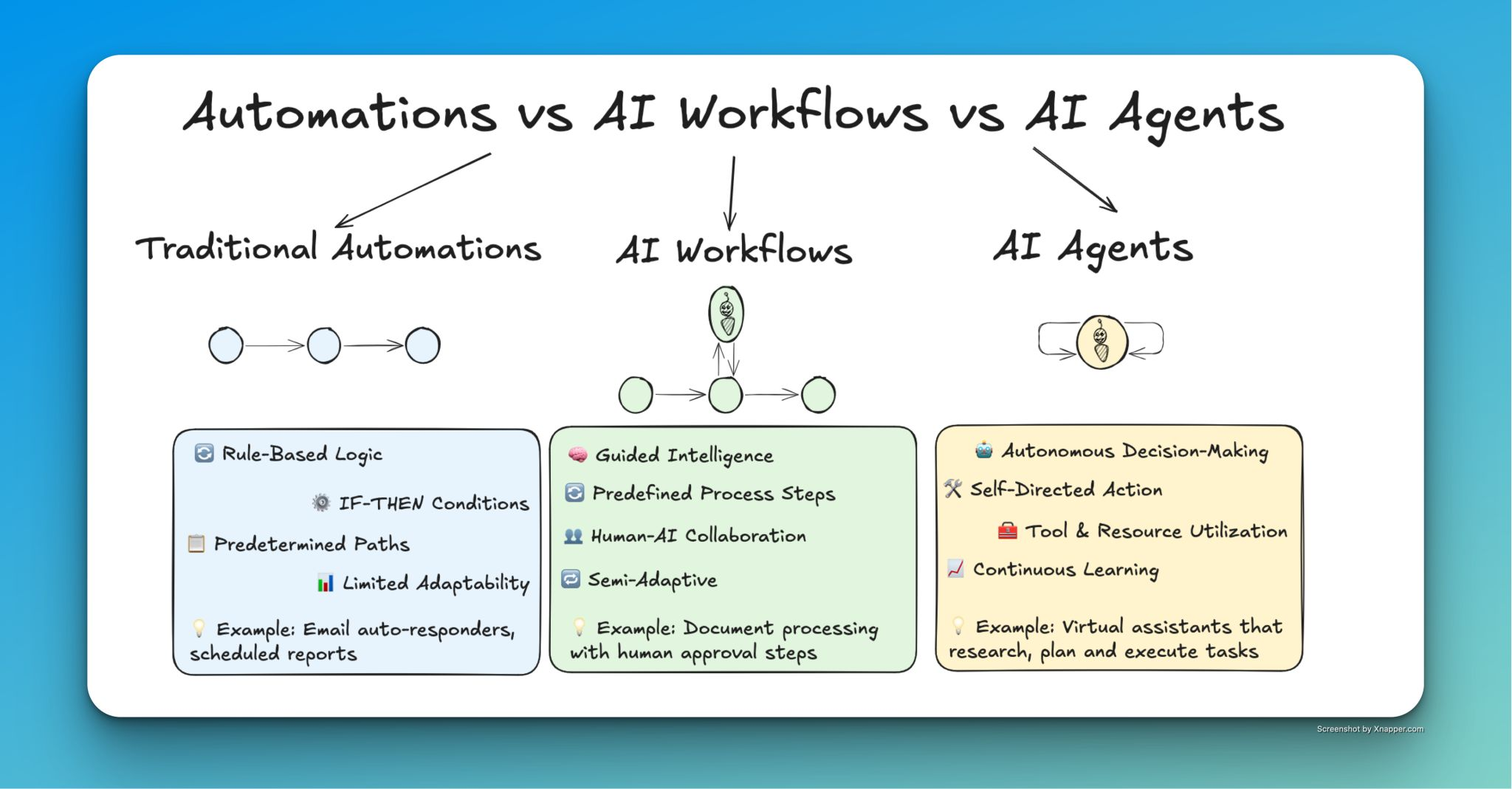
Automation: Following Rules
Definition: Automation executes predefined instructions without deviation. If-then logic, scripted workflows, deterministic outcomes.
Characteristics:
- Zero autonomy - Follows exact instructions
- Predictable - Same input always produces same output
- Fast and reliable - No AI inference overhead
- Limited scope - Can’t handle unexpected situations
Example Use Cases:
- Scheduled database backups
- Email notifications on system events
- Data pipeline transformations
- API integrations with fixed mappings
When to Use:
- Requirements are clearly defined and stable
- Edge cases are known and handleable with rules
- Speed and reliability matter more than flexibility
- Cost efficiency is critical (no AI API costs)
AI Workflows: Adaptive Execution
Definition: AI Workflows adapt within set parameters, using LLMs for specific decision points while maintaining overall structure.
Characteristics:
- Guided autonomy - Makes decisions within predefined boundaries
- Adaptive - Handles variations and expected edge cases
- Hybrid approach - Combines rules with AI reasoning
- Predictable structure - Overall flow is predetermined
Example Use Cases:
- Content moderation (flag + AI classification)
- Customer support triage (route to right team based on AI analysis)
- Document processing (extract data with AI, validate with rules)
- Smart notifications (AI determines urgency, rules handle delivery)
When to Use:
- Requirements have known variations
- Human-like judgment needed at specific points
- Overall process structure is stable
- You need explainability at each step
AI Agents: Autonomous Problem Solvers
Definition: AI Agents proactively solve problems by independently choosing tools, strategies, and approaches to achieve goals.
Characteristics:
- High autonomy - Decides how to accomplish objectives
- Goal-oriented - Given outcomes, not instructions
- Adaptive strategy - Learns and evolves approach
- Unpredictable paths - May solve problems in unexpected ways
Example Use Cases:
- Research assistants that gather, synthesize, and analyze information
- Code debugging agents that investigate and fix issues
- Personal assistants that manage complex multi-step tasks
- Data analysis agents that explore datasets and find insights
When to Use:
- Problem space is complex and evolving
- Multiple valid approaches exist
- Human-level reasoning is required throughout
- You need the system to handle novel situations
The Critical Differences
Decision-Making Authority
| Aspect | Automation | AI Workflows | AI Agents |
|---|---|---|---|
| Who decides what to do | Developer (hardcoded) | Developer defines flow, AI fills gaps | AI decides approach |
| Adaptability | None | Within parameters | Learns and evolves |
| Error handling | Predefined fallbacks | AI-assisted recovery | Agent determines fix |
| Unpredictability | None | Low | High |
Complexity vs Control
Automation:
- ✅ Full control and predictability
- ✅ Easy to debug and maintain
- ❌ Brittle when requirements change
- ❌ Can’t handle unexpected inputs
AI Workflows:
- ✅ Balanced control and flexibility
- ✅ Handles variations gracefully
- ❌ More complex than pure automation
- ❌ AI decisions need monitoring
AI Agents:
- ✅ Maximum flexibility and capability
- ✅ Handles novel situations
- ❌ Unpredictable execution paths
- ❌ Harder to debug and constrain
Cost Considerations
Automation:
- No AI API costs
- Minimal compute resources
- Maintenance only when requirements change
AI Workflows:
- AI costs at specific decision points
- Predictable usage patterns
- Balance between cost and capability
AI Agents:
- Potentially high AI API costs (multiple calls, iterations)
- Unpredictable token consumption
- Need cost guardrails and monitoring
Choosing the Right Approach
Start with This Decision Tree
-
Are requirements fully defined and stable?
- Yes → Use Automation
- No → Continue
-
Can you map out the overall process flow?
- Yes → Use AI Workflows
- No → Continue
-
Do you need the system to figure out how to achieve goals?
- Yes → Use AI Agents
Real-World Examples
Email Processing:
- Automation: Forward emails with specific keywords to departments
- AI Workflow: Classify email intent → Route to team → Generate suggested response
- AI Agent: Analyze email, research context, draft complete response, and learn from feedback
Data Pipeline:
- Automation: ETL with fixed transformations
- AI Workflow: Extract with AI (OCR, parsing) → Validate with rules → Load to database
- AI Agent: Explore data quality issues, propose and implement fixes, optimize schema
Customer Support:
- Automation: FAQ bot with keyword matching
- AI Workflow: Classify issue → Check knowledge base → Escalate if needed
- AI Agent: Understand problem, investigate logs, propose solutions, verify fixes
Practical Implementation Considerations
Testing Strategies
Automation:
- Unit tests for each rule
- Integration tests for workflows
- 100% code coverage feasible
AI Workflows:
- Test predetermined paths
- Validate AI decisions with golden datasets
- Monitor AI component accuracy
AI Agents:
- Define success criteria, not execution paths
- Use simulation environments
- Extensive monitoring in production
Monitoring Requirements
Automation:
- Success/failure metrics
- Execution time
- Error rates
AI Workflows:
- All automation metrics plus:
- AI decision quality
- Token usage per step
- Human override frequency
AI Agents:
- All workflow metrics plus:
- Goal completion rate
- Cost per task
- Novel approach discovery
- Safety constraint violations
The Future: Agentic Systems
The trend is clear: we’re moving from automation toward more autonomous systems. However, most production systems will be hybrids:
- Critical paths remain automated for reliability
- AI workflows handle variations and user interactions
- AI agents tackle complex, open-ended problems
The key is using the right tool for each job within your larger system.
Summary
Understanding the autonomy spectrum helps you make better architectural decisions:
Key Takeaways:
- Automation = Rules without deviation (fast, cheap, predictable)
- AI Workflows = Structured processes with AI decision points (balanced flexibility)
- AI Agents = Autonomous problem-solvers (maximum capability, unpredictable)
Decision Framework:
- Known requirements + Stable environment = Automation
- Defined process + Variable inputs = AI Workflows
- Complex goals + Evolving problems = AI Agents
Best Practice: Start simple. Begin with automation, introduce AI workflows where judgment is needed, and reserve agents for truly complex problems. You can always evolve your system as requirements grow.
Looking for more AI content? Check the llm tag for related posts.
January 2026